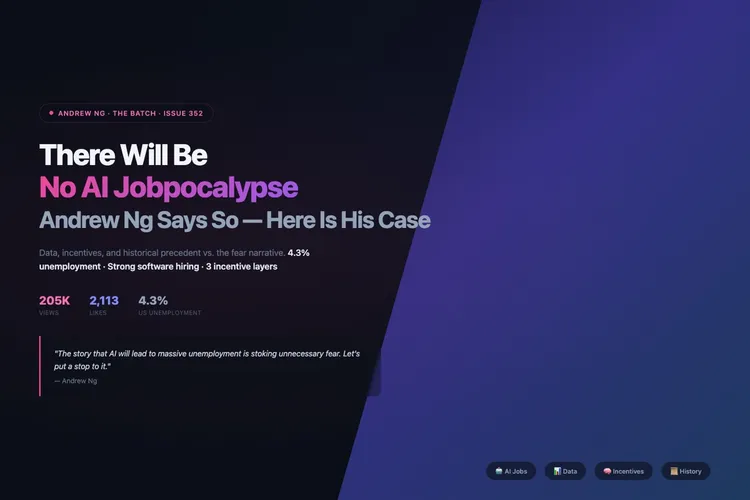
Andrew Ng Says There Will Be No AI Jobpocalypse — Here Is His Case
In the early hours of May 13, 2026, Andrew Ng posted a sharply worded thread on X. The title was one sentence: “There will be no AI jobpocalypse.” The opening was even more direct — the story that AI will lead to massive unemployment is stoking unnecessary fear. AI, like any other technology, does affect jobs, but telling overblown stories of large-scale unemployment is irresponsible and damaging, and it is time to put a stop to it. This is not the first time Ng has expressed skepticism about the jobpocalypse narrative, but this post offers his most complete case yet — dismantling the structural weaknesses of the AI unemployment thesis through data, incentive analysis, and historical precedent.
Within hours, the post accumulated 200,000 views, over 2,100 likes, and nearly 600 reposts. The numbers reflect something worth paying attention to: when an AI leader with academic authority (Stanford adjunct faculty), industry experience (former head of Baidu AI Group, co-founder of Google Brain), and entrepreneurial perspective (Coursera co-founder) makes a systematic judgment on this topic, the market should listen. His argument operates on three distinct levels.
The data: the most AI-disrupted sector is still hiring
Ng chose a counter-intuitive entry point. Rather than speak in generalities about AI not replacing jobs, he went straight at the sector most likely to be disrupted: software engineering. Coding agents have been the fastest-improving AI application category over the past eighteen months. Tools like Claude Code, Cursor, and Copilot keep pushing their capability boundaries forward. If any industry were destined to be hollowed out by AI, software engineering would be ground zero.
The actual numbers tell a different story. Despite coding agents racing ahead at breakneck pace, hiring of software engineers remains strong. This is not an anecdotal datapoint from one company — it is a macro trend. Ng’s assessment is that net job creation vastly exceeds net job destruction, consistent with every previous wave of technology. And despite all the exciting progress in AI, the U.S. unemployment rate sits at a healthy 4.3 percent. That figure is difficult to reconcile with the narrative that AI is destroying large numbers of jobs at scale.
Critics will point out that unemployment is a lagging indicator. But Ng’s argument does not depend on a single datapoint — it relies on a long-running pattern. Every wave of technological change has been accompanied by a “this time is different” fear of job loss, and every time the labor market has ultimately created far more roles than it eliminated. Agricultural mechanization eliminated farm labor and created industrial jobs. Industrial automation eliminated assembly-line work and created service-sector jobs. The computer revolution eliminated typists and file clerks and created the entire employment landscape of the internet age. There is no evidence that AI will break this four-decade pattern.
The incentives: three groups driving the narrative
If the data does not support the AI jobpocalypse thesis, why does the narrative persist with such force? Ng offers three sharp incentive analyses, and this is the most valuable section of his entire post.
The first group is frontier AI labs. They have strong incentives to tell stories that make AI technology sound as powerful as possible. At their most extreme, they promote science-fiction scenarios of AI “taking over” and causing human extinction. The logic chain is straightforward: if a technology can replace many employees, surely that technology must be very valuable. Fear itself functions as a product value signal. This is not conspiracy theory — it is market incentives at work. When your investors need to believe AGI is imminent, and when your talent needs to believe they are changing the world, you naturally gravitate toward the most dramatic version of your story.
The second group is AI companies, and their pricing strategy reveals the real driver. Typical SaaS software companies charge between one hundred and one thousand dollars per user per year. But if an AI company can replace an employee who makes one hundred thousand dollars — or make them fifty percent more productive — then charging even ten thousand dollars starts to look reasonable. By anchoring their pricing not to typical SaaS price points but to employee salaries, AI companies can charge significantly more. This anchoring effect explains why AI product price curves sit far above traditional software: not because costs are higher, but because the value narrative allows for higher pricing.
The third group is business managers. Attributing layoffs to AI is a public-relations convenience. By talking about how they are using AI to be far more productive with fewer staff, companies look smarter and more forward-thinking. This is a much better message than admitting they overhired during the pandemic, when capital was abundant due to low interest rates and massive government financial stimulus. Ng uses a precise word — “overhired” — to describe what actually happened during the great tech expansion of 2021 and 2022. When the tide went out, blaming layoffs on “being replaced by AI” rather than “the bubble bursting” served both as managerial dignity and as a production source for the fear narrative.
These three incentive layers stack into a self-reinforcing cycle: AI labs manufacture fear narratives, AI companies use those narratives to justify premium pricing, and enterprises use them to excuse post-bubble layoffs. Each layer amplifies the same signal.
Historical patterns: when societies tell themselves wrong stories
Ng draws on three historical examples to illustrate the power of narrative. Fears over nuclear plant safety led the world to under-invest in nuclear power for decades. Fears of the “population bomb” in the 1960s drove multiple countries to implement harsh population-control policies. Worries about dietary fat led governments to promote unhealthy high-sugar diets that persisted for decades. Each of these fears had some basis in reality — nuclear accidents did happen, populations were growing rapidly, and high-fat diets were linked to heart disease. But each fear, once amplified beyond reasonable proportion, led to systematically wrong policy decisions.
The AI unemployment narrative is following the same trajectory. Ng expresses relief that mainstream media has begun pushing back on the jobpocalypse story, and he hopes these stories will start to lose their teeth. His confidence is not baseless: the fear of “AI causing human extinction” has already begun receding from mainstream discourse over the past few years, and the same process may play out for the unemployment narrative.
The counter-thesis: an AI jobapalooza
Ng closes with a direct counter-prediction. Not an AI jobpocalypse, but an AI jobapalooza. AI will generate a large number of high-quality AI engineering jobs. What AI engineers do will look different from traditional software engineering, and many of these positions will be in businesses that are not traditionally large employers of developers. In non-AI roles, too, the skills required will shift because of AI.
This points to a core conclusion: the present moment is the best time to encourage more people to become proficient in AI and make sure they are ready for the different but plentiful jobs of the future. Ng is not saying everything will automatically work out. He is saying the fear narrative itself is our biggest obstacle. The real loss happens when people avoid learning AI because they are afraid of being replaced. The real damage happens when policymakers write regulations based on fear rather than data. The real stagnation happens when companies slow AI adoption because they worry about negative side effects that the data does not support.
When a society’s dominant narrative diverges from the evidence, people with influence and responsibility should step in to correct course. With this post, Andrew Ng did what he could.
AI will not eliminate jobs — it will redefine them. And the redefinition, whether painful or exhilarating, needs clear-headed judgment more than it needs alarming headlines.